
I’ve spent much of my career inside complex systems.
Pharmaceutical manufacturing. Clinical environments. Validation programs. Global audits. Quality organizations spread across geographies, technologies, and operating cultures.
Across all of it, I’ve seen a recurring pattern:
Organizations build governance frameworks as though systems stay still.
They don’t.
That was already a problem before AI.
AI just makes the problem impossible to ignore.
Traditional governance models were built for relatively static environments.
You define requirements. Validate against them. Approve the system. Document the evidence. Move on.
That model made sense when software behaved predictably and change was relatively controlled.
But what happens when the system adapts?
What happens when models evolve?
What happens when agents begin making decisions, coordinating tasks, escalating exceptions, or collaborating with humans in ways that weren’t explicitly scripted?
At that point, governance can no longer be treated as a document exercise.
It becomes infrastructure.
That distinction matters.
Because I believe many organizations are solving tomorrow’s problem with yesterday’s assumptions.
A Pattern Is Emerging
Lately, I’ve been noticing something interesting.
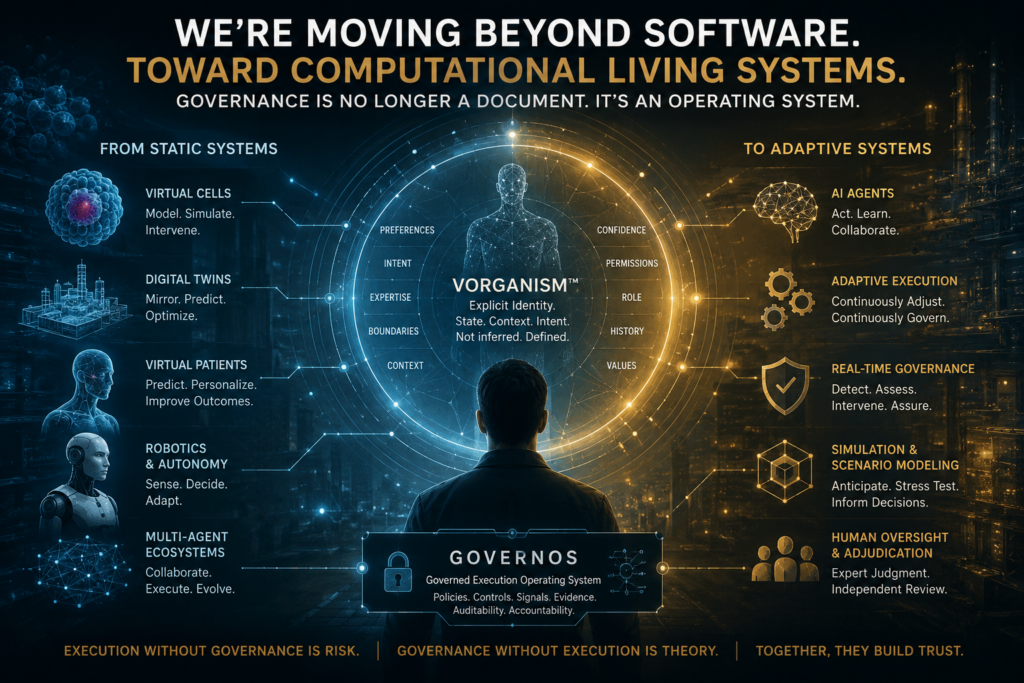
Different disciplines, with very different missions, seem to be converging toward similar architectures.
Computational biology is building virtual cells.
Manufacturing uses digital twins.
Robotics increasingly depends on adaptive sensing and autonomous decision loops.
AI is moving toward agentic execution.
Healthcare is exploring virtual patients and predictive intervention models.
At first glance, these look unrelated.
I don’t think they are.
I think they’re all signals of a deeper architectural shift.
We’re moving away from static software systems and toward something more dynamic.
State-aware systems.
Signal-responsive systems.
Systems that adapt based on context.
Systems that can be simulated, monitored, intervened upon, and continuously governed.
Not “alive” in the biological sense.
But architecturally, increasingly reminiscent of living systems.
That changes everything.
Governance Is Not a Policy Problem
I’ve said this before, and I believe it even more now:
AI governance is not a policy problem. It’s an execution architecture problem.
Policies matter.
Principles matter.
Governance boards matter.
But none of those are sufficient if the system itself cannot operationalize expectations in real time.
If drift occurs, what triggers action?
If a model changes, what governance state changes with it?
If risk conditions evolve, who—or what—detects that?
If autonomous systems begin collaborating, where is accountability enforced?
These are architectural questions.
Not documentation questions.
And regulated industries, in particular, should understand this better than most.
Validation has always been about trust.
The problem is that many validation models still assume trust can be established at a point in time.
Increasingly, trust is becoming a continuously maintained operational state.
The Human Blind Spot
One of the more interesting questions is how humans fit into all of this.
Today, many systems infer who we are through behavior.
Clicks.
Patterns.
Usage.
Predictions.
In some cases, the system may predict our behavior remarkably well.
But inference is not identity.
Prediction is not understanding.
There’s a meaningful difference between being behaviorally modeled and explicitly represented.
That distinction becomes more important as AI becomes more capable.
Because human-AI collaboration should not rely entirely on passive inference.
I believe we’re moving toward systems where participation becomes more explicit.
Where identity, intent, boundaries, preferences, expertise, confidence, and context can be represented more deliberately rather than guessed at from digital exhaust.
That creates entirely different governance possibilities.
And frankly, entirely different ethical questions.
Why My Perspective Changed
Years ago, during global audits, I repeatedly saw governance fail in predictable ways.
Different sites interpreted standards differently.
Different quality groups made inconsistent decisions.
Corporate oversight often happened after the fact, looking at rolled-up outcomes rather than governing execution as it unfolded.
The issue wasn’t that people lacked procedures.
The issue was that enforcement lived outside the operating system.
That lesson stayed with me.
Because AI introduces the same governance challenge, just at much greater scale and speed.
If governance remains external, retrospective, and document-centric, the gap only widens.
A Different Category May Be Emerging
I suspect we may need new language for what’s happening.
Perhaps the right framing is:
Computational Living Systems.
Not because machines are alive.
But because many of the systems we’re building increasingly share structural characteristics with adaptive living systems:
- state
- signals
- feedback
- intervention
- adaptation
- simulation
- resilience
- continuous governance
If that framing holds, then the question shifts.
Not:
Can AI do this?
But:
What architecture ensures it does so safely, transparently, and in a governable way?
That feels like one of the defining infrastructure questions of this decade.
Final Thought
Every major technology era changes the systems we build.
Some also change how we define ourselves.
I think AI may be doing both.
And if we continue treating adaptive, autonomous, stateful systems as though they are merely upgraded versions of traditional software, we’re going to create governance models that fail precisely where trust matters most.
Governance cannot remain adjacent.
It has to become part of execution itself.